One of the most frequent questions I receive from SCMDOJO followers pursuing a Master’s or PhD in Supply Chain Management from leading universities in Europe, the UK, or the USA is:
“I need a solid, modern Master’s Thesis idea in Supply Chain. Where do I start?”
As we navigate 2026, the global supply chain landscape has shifted dramatically. The traditional methods of SCM relying on historical data, static quarterly planning cycles, and reactive risk mitigation are no longer sufficient. If you want your thesis to stand out to academic supervisors and future employers, your research must address the two massive forces redefining our industry today: Agentic AI and Continuous Resilience.

We are transitioning from predictive AI to Agentic AI where autonomous software agents do not just forecast a disruption, but actively negotiate, reroute, and self-heal the supply chain. Simultaneously, geopolitical instability, nearshoring infrastructure gaps, and strict green mandates (like the EU’s Corporate Sustainability Due Diligence Directive – CSDDD) have made Continuous Resilience the new baseline.
To set you up for absolute academic and professional success, here is the ultimate curated directory of exactly 108 unique, non-duplicated Supply Chain Management thesis topics for 2026, organized by strategic research domains.
The 108 SCM Thesis Topics for 2026
1. Agentic AI & Autonomous SCM Orchestration (12 Topics)
- Transitioning from Predictive to Agentic AI: Developing Frameworks for Autonomous Exception Management in Logistics
- Cognitive Human-Machine Orchestration: Re-evaluating Warehouse Labor Roles in AI-Managed Operations
- Multi-Agent Reinforcement Learning: Applications for Dynamic Ocean Freight Rate Negotiation
- Synthetic Data Generation in Supply Chain Modeling: Overcoming Data Scarcity for Extreme Event Prediction
- The Shift to Continuous Supply Chain Planning: Breaking the Monthly S&OP Cycle with Real-Time AI Integration
- Explainable AI (XAI) in Strategic Sourcing: Building Stakeholder Trust in Algorithmic Decision-Making
- Generative AI for Supplier Discovery: Evaluating Bias, Speed, and Efficiency in Automated Sourcing
- Generative AI for Contract Automation: Efficiency Gains vs. Risk Exposure in Procurement
- AI-Driven Impact Analysis: Simulating Upstream and Downstream Consequences of Autonomous SCM Decisions
- Human-AI Collaboration Metrics: Tracking the Productivity Ratio Between Human-Led and Machine-Led Tasks
- Natural Language Processing (NLP) Applications in Supplier Relationship Management and Contract Analysis
- AI and Machine Learning for Supply Chain Risk Prediction and Early Warning Systems
2. Geopolitical Risk, Nearshoring & Friendshoring (12 Topics)
- Navigating the 2026 Tariff Landscape: Cost Absorption Strategies and Margin Defense Mechanisms for Retailers
- Infrastructure Gaps in Nearshoring: A Capacity Assessment of North American and Mexican Logistics Corridors
- Geopolitical Decoupling and Friendshoring: Restructuring Defense and High-Tech Supply Chains
- Continuous Scenario Planning: Transitioning from Periodic Planning to Real-Time Resilience Models
- Tariff Volatility and Sourcing Agility: A Framework for Near-Real-Time Supplier Network Reconfiguration
- Economic Sanctions and Trade Compliance: Achieving Global Tier-2 and Tier-3 Supplier Visibility
- Supply Chain Contagion: Predictive Modeling for Supplier Bankruptcy Cascades in High-Interest Rate Environments
- Strategic Redundancy vs. Cost Efficiency: Evaluating Dual-Supplier Models in Critical Minerals Sourcing
- Climate-Risk Mapping in Global Food Supply Chains: Predictive Disruption and Adaptive Capacity
- The Impact of Maritime Canal and Red Sea Crises on Global Shipping: Long-term Route Diversification Strategies
- Stress-Testing Global Networks: How Geopolitical Risk Indices Inform Modern Sourcing Decisions
- Custom Compliance and Trade Regulations: Impact on Supply Chain Strategy in Multi-Country Operations
3. Sustainability, ESG & Green SCM Compliance (12 Topics)
- Measuring Scope 3 Emissions: Carbon Accounting Standards and Upstream Reporting Challenges
- The EU Corporate Sustainability Due Diligence Directive (CSDDD): Compliance Burdens on Tier-3 Suppliers in Emerging Markets
- Carbon Border Adjustment Mechanism (CBAM) Readiness: Strategic Sourcing Shifts in Heavy Manufacturing
- Carbon Insetting vs. Carbon Offsetting in Logistics: Financial and Environmental Efficacy in FMCG
- Renewable Energy Procurement in Tier-1 Manufacturing: Evaluating Long-Term Supply Chain Stability
- Supplier Human Rights Auditing in 2026: Technology-Driven Traceability vs. Traditional Field Assessments
- Zero-Deforestation Regulations (EUDR): Traceability Innovations in Agricultural Commodities Sourcing
- ESG Metrics as Core KPIs: Moving from Compliance Reporting to Enterprise Value Creation
- Implementation of Green Supply Chain Management Practices: Barriers and Enablers Across Industries
- How Supply Chains Can Be Simultaneously Sustainable and Competitive: Strategy Framework Development
- Sustainable Project Management (SPM): Applying SPM Models to Supply Chain Network Transformations
- Ethical and Sustainable Procurement Practices: An Examination of Implementation Challenges and Benefits
4. Circular Economy & True Reverse Logistics (12 Topics)
- Beyond End-of-Life: Integrating Repairability and Upcycling into Original Supply Chain Design
- Reverse Logistics Economics in Consumer Electronics: The Impact of “Right-to-Repair” Legislation
- Closed-Loop Supply Chains for EV Batteries: Evaluating Infrastructure, Cost, and Recycling Efficiency
- From Single-Use to Returnable Packaging: Adoption Barriers and Cost Modeling in B2B Logistics
- Circular Public Procurement: How Government Purchasing Power Can Drive Eco-Design Supply Chains
- Microplastic Reduction Interventions: Feasibility and Economic Impact Across the Textile Supply Chain
- Take-Back Programs in Fast Fashion Retail: Evaluating Consumer Behavior and Operational Costs
- Extended Producer Responsibility (EPR): Compliance and Reverse Logistics Optimization for Global Brands
- The Role of 3D Printing in the Circular Economy: Localized Spare Parts Manufacturing
- Circular Economy Regulations and SME Responses: Compliance Challenges for Smaller Suppliers
- Circular Economy Practices in Supply Chain Management: A Case Study Approach
- Inventory Obsolescence and Write-Off Management in Fast-Moving Consumer Goods (FMCG) Circular Supply Chains
5. Digital Twins & Predictive Simulation (12 Topics)
- Operational Digital Twins: Stress-Testing Networks Against Port Strikes and Climate Events
- Simulating Supply Chain Disruption: How Digital Twin Predictions Align with Real-World Outcomes
- Digital Twins for Warehouse Layout Optimization: Maximizing Space Utilization and Picker Routing
- Network Design Optimization: Using Digital Twins for Cross-Docking and Hub-and-Spoke Modeling
- Virtual Commissioning in Manufacturing: Reducing Downtime Through Digital Twin Implementation
- Real-Time Logistics Control Towers: Measuring ROI on Exception Management and End-to-End Visibility
- Predictive Maintenance Strategies in Industry 4.0: A Case Study Approach to IoT Integration
- Simulating Inventory Placement: AI-Driven Positioning for High-Demand Consumer Goods
- Digital Twins in the Cold Chain: Ensuring Temperature Integrity in Pharmaceutical Logistics
- Bridging Planning and Execution: The Role of Digital Twins in S&OP Maturity
- Evaluating Technology Adoption Maturity in Modern Supply Chain Management
- The Practicability of Intertwined Supply Networks with IoT: Technical and Organizational Barriers
6. Robotics, Automation & Future Logistics Labor (10 Topics)
- Polyfunctional Robotics in Fulfillment Centers: Overcoming Labor Shortages Through Flexible Automation
- Teleoperations and Remote Workforce Management: Applications in Automated Ports and Warehouses
- Augmented Reality (AR) on the Shop Floor: Impact on Picking, Sorting, and Operational Training
- Industrial IoT and 5G Edge Computing: Reducing Latency in Real-Time Inventory Tracking Systems
- Autonomous Guided Vehicles (AGVs) in Heavy Manufacturing: Safety and Efficiency Improvements
- Human-Robot Collaboration in Logistics: Measuring the Reduction of Human Error in Critical Activities
- Low-Code Automation in Supply Chain Administration: Reducing Bottlenecks in the Procure-to-Pay Cycle
- Machine Vision for Quality Control: Identifying Counterfeits in Luxury Supply Chains
- Wearable Technology in Warehousing: Ergonomics, Productivity, and Employee Wellbeing
- Talent Acquisition for Next-Gen Logistics: Bridging the Gap Between Traditional Operations and Data Science
7. Strategic Sourcing, S&OP & Procurement 5.0 (12 Topics)
- The Evolution of Procurement KPIs: Moving from Pure Cost-Savings to Supply Chain ‘Total Value’ Creation
- Cost-Modeling vs. Open-Book Pricing: Trust Dynamics in Long-Term Strategic Contracts
- Evolving Category Management Strategies: Responses to Sustained Global Material Shortages
- Supplier Diversity Programs in Corporate Sourcing: Measuring Impact on Innovation and Resilience
- Digital Procurement Platforms: Cost Control Effectiveness and Adoption Barriers for SMEs
- Strategic Sourcing in the Semiconductor Industry: Navigating Geopolitics and Long Lead Times
- Supplier Relationship Management (SRM) in 2026: Transactional Purchasing vs. Collaborative Innovation
- Contingent Labor Procurement: Analyzing Worker Outcomes and Supply Chain Flexibility
- Procurement Digitalization Maturity: A Benchmarking Study Across Mid-Market Firms
- Consortia Buying Strategies: Outcomes and Limitations in the Higher Education and Healthcare Sectors
- Integrated Business Planning (IBP) Maturity: Organizational Readiness and Implementation Frameworks
- Collaborative Demand Planning with Customers and Suppliers: Benefits and Implementation Barriers
8. Last-Mile Delivery & Omnichannel Fulfillment (14 Topics)
- Hyper-Localized Micro-Fulfillment Centers (MFCs): AI-Driven Inventory Positioning for Sub-Same-Day Delivery
- Addressing SKU Proliferation in Omnichannel Retail: Inventory Rationalization Strategies
- Crowd-Sourced Logistics Platforms vs. Traditional Carriers: Cost Structure and Reliability Trade-offs
- Sustainable Last-Mile Delivery: Balancing Zero-Emission Mandates with High-Frequency Demands
- Dark Stores and Urban Distribution: Reimagining Retail Real Estate for E-Commerce Efficiency
- Reverse Logistics in Fast Fashion: The Financial Impact of High Return Rates in E-Commerce
- Cross-Border E-Commerce Logistics: Navigating Customs Compliance and Tariff Optimization
- The Cold Chain in Urban Environments: Innovations in Last-Mile Grocery and Meal Kit Delivery
- Collaborative Last-Mile Logistics: Competitors Sharing Distribution Assets to Reduce Carbon Output
- Demand Forecasting for Short-Lifecycle Products: The Impact of Viral Social Media Trends on Inventory Planning
- The Operational Viability of Drone Fleets: Urban Last-Mile Logistics and Regulatory Hurdles
- Impact of Mobility Solutions and Latest Technologies on Logistics: Autonomous Vehicles and Drones
- E-Commerce Supply Chain: Challenges in Handling High SKU Variety and Reverse Logistics
- Cross-Docking and Hub-and-Spoke Models: Network Design Optimization for Rapid Distribution
9. SCM Finance, Trust & Operational Excellence (12 Topics)
- The Carbon Cost of Safety Stock: Integrating Emissions into Multi-Echelon Inventory Optimization Models
- Everything-as-a-Service (XaaS) in Logistics IT: Evaluating Operational Agility Over Legacy Monolithic ERP Systems
- Blockchain Technology for Deep-Tier Transparency: Evaluating the Impact on Traceability and Trust
- Smart Contracts in Procurement: Automating Supplier Agreements and Payment Settlements
- Cybersecurity Vulnerabilities in Digitalized Supply Chains: Threat Mitigation in Supplier Portals
- Ransomware Attacks on Global Logistics: Incident Response Strategies and Business Continuity Planning
- Interoperability Challenges in Multi-Party Blockchain Systems: Standards and Governance Models
- Blockchain-Enabled Supply Chain Finance: Tokenization, Factoring, and SME Working Capital Optimization
- Securing the IoT Network: Penetration Testing and Vulnerability Assessment in Smart Warehouses
- Working Capital Optimization Through Inventory Management: Cash Conversion Cycle Reduction
- Supply Chain Finance Solutions: Inventory Financing, Supplier Financing, and Dynamic Discounting
- Safety Stock and Service Level Trade-Offs: Optimization Models for Multi-Echelon Networks
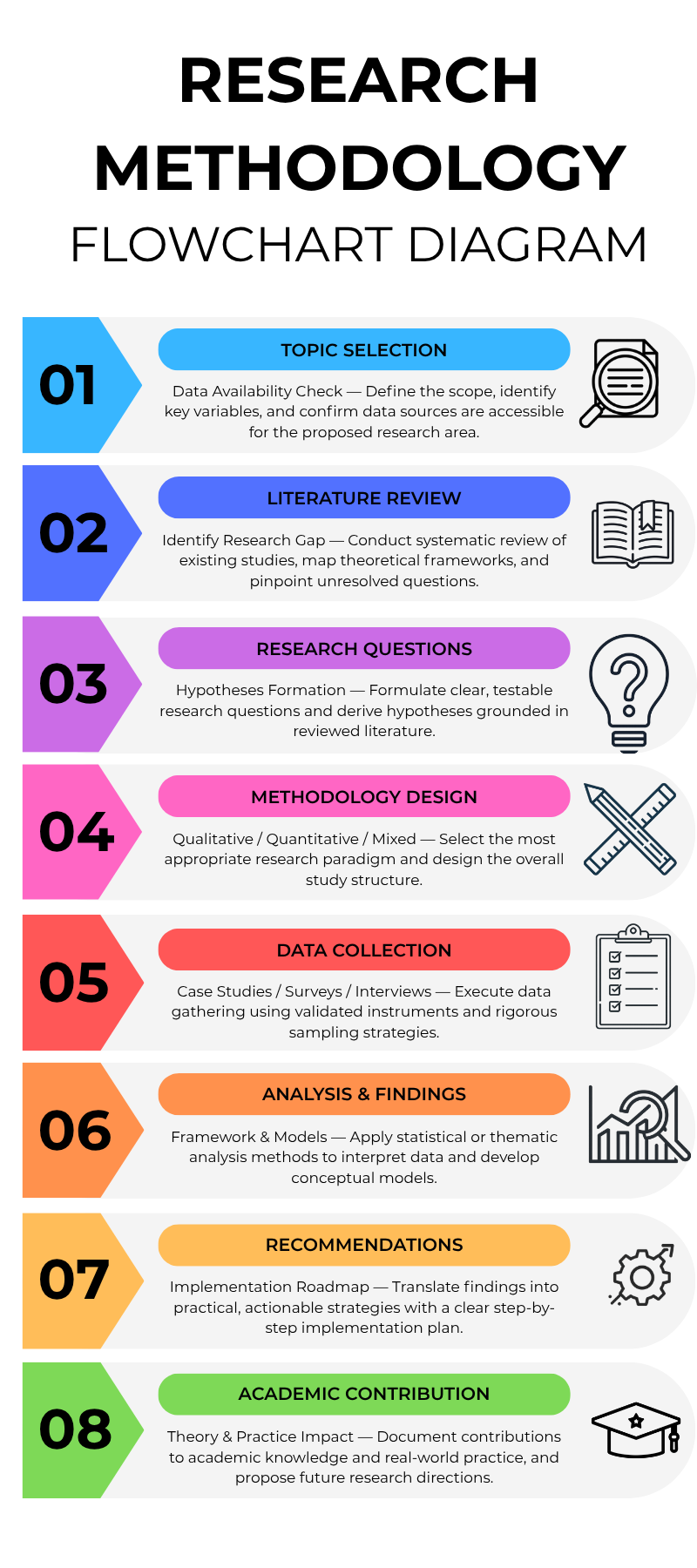
8-Step Research Methodology Framework
Once you have selected your SCM thesis topic, executing it with academic rigor is crucial. Use the following 8-Step Research Methodology Flowchart to map out your academic journey from concept to final contribution:
Key Success Factors for Your Thesis Selection
When finalizing your SCM topic, run it through this quick checklist to ensure viability:
- Data Availability & Accessibility: Confirm you can access the primary data (surveys, interviews) or secondary datasets (ERP exports, public indices) required to answer your research question. Avoid topics requiring proprietary corporate data that you do not have pre-approved access to.
- Industry Relevance & Timeliness: Prioritize topics that solve active, real-world industry headaches in 2026 rather than legacy problems.
- Academic Supervisor Alignment: Align your chosen topic with your supervisor’s research background to secure stronger guidance, mentorship, and grading.
- Feasibility & Scope: Narrow down your geographical, sectoral, or organizational scope. A highly focused study (e.g., “Agentic AI in Mexican automotive nearshoring corridors”) is vastly superior to a broad, generic study.

Watch my YouTube vlog explaining more on Top 10 HOT TOPICS for Supply Chain Research for Master Thesis or Ph.D. Thesis.
Finally,
The supply chain systems of today are more likely to see massive changes technologically in the coming years. Some selected supply chain management thesis topics may face limited data or access to real-time data in making proper research and forecast, including seasonality and trends. So, due diligence is necessary to ensure you not only pick an exciting supply chain management thesis, but you also have sufficient access to data, studies, and materials useful in such an area. The impact of these trends alongside technological advancement in the selected areas would certainly help your thesis stand out and unique.
Note: If you’re using AI to generate thesis drafts or outlines, tools like AI humanizer can help polish the language to suit academic expectations.
If are looking for more articles in the education category, you can visit this page
Frequently Asked Questions (FAQ)
What are the emergent research topics in the field of supply chain management?
If you are researching SCM in 2026, the most emergent topics include:
- Agentic AI & Automation: Transitioning from predictive analytics to AI systems that autonomously negotiate, reroute, and solve logistics disruptions.
- Continuous Resilience & Geopolitics: Building supply chains capable of adapting to permanent disruptions, friendshoring, and new tariff landscapes.
- Verifiable Sustainability: Navigating strict new ESG mandates (like the EU’s CSDDD) and tracking Scope 3 carbon emissions.
- Circular Economy: Moving beyond recycling to deep-tier reverse logistics, “right-to-repair” legislation, and upcycling.
- Supply Chain Visibility & Digital Twins: Using real-time digital simulations to stress-test global networks against climate and port disruptions.
What are the 4 main areas of supply chain management?
The core pillars of SCM are:
- Planning
- Sourcing
- Making
- Delivering
What is the primary goal of modern Supply Chain Management?
The main goal of SCM is to orchestrate the flow of goods, data, and finances from origin to consumption. While historically focused purely on cost reduction and efficiency, modern SCM must balance efficiency with sustainability, verifiable compliance, risk resilience, and continuous adaptability.
What is the difference between a “supply chain” and “supply chain management”?
The term “supply chain” refers to the physical network of entities, assets, and processes involved in creating and delivering a product encompassing suppliers, manufacturers, distributors, retailers, and customers. “Supply chain management (SCM),” on the other hand, is the strategic coordination, integration, and oversight of these interconnected processes to optimize efficiency and gain a competitive edge.
Can I use AI to assist with my thesis? Yes, but ethically. AI is incredibly useful for generating literature structures, refining arguments, and polishing drafts. However, you must always adhere to your university’s academic integrity policies regarding AI disclosure.
Recommended Books



Dr. Muddassir Ahmed is a globally recognized supply chain expert, thought leader, and keynote speaker. As the Founder & CEO of
 SCMDOJO, he has built one of the world’s leading platforms dedicated to empowering supply chain professionals with cutting-edge knowledge, practical tools, and access to expert insights. With over 19 years of leadership experience spanning the UK, Europe, the Middle East, and Southeast Asia, Dr. Ahmed has held key roles at Bridgestone, Doncasters Group, Eaton, and Volvo Cars, managing multi-million-dollar supply chain operations.
His expertise spans all facets of supply chain management, with a particular focus on leveraging technology and innovation to optimize processes and build resilient supply chains.
Recognized among the Top 10 Supply Chain Influencers in the World by Supply Chain Digital, Dr. Ahmed has been instrumental in shaping industry best practices through his extensive research, vlogs, and thought leadership. Holding a PhD in Management Science from Lancaster University Management School, he is also a certified Six Sigma Black Belt.
His platform, SCMDOJO, serves a vibrant community with over 51,000 monthly visitors. Moreover, he has 72,000 newsletter subscribers, and a social media following exceeding 105,000 supply chain professionals
A sought-after keynote speaker and thought leader, sharing his insights on industry trends, best practices, and the future of supply chain management. Dr. Ahmed delivers high-impact talks on supply chain excellence, digital transformation, and strategic leadership. His mission is clear: to help supply chains thrive
You can follow him on LinkedIn, Facebook, Twitter